
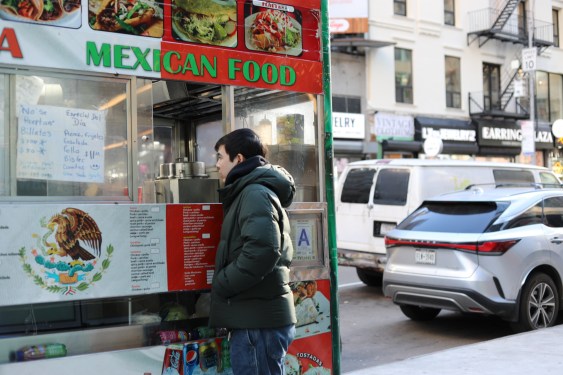
Food carts are a staple of New York City dining, serving everything from dosa and doner kebabs to hot dogs and dim sum. However, the smelly gas generators that power these carts often threaten to spoil the appetizing aromas of the food.
This nuisance may soon be a thing of the past. A Brooklyn-based startup is now testing the use of its e-bike batteries to power food carts, beginning with a trial at La Chona Mexican on the corner of 30th and Broadway in Manhattan.
The idea began informally last summer. David Hammer, co-founder and CEO of PopWheels, described it as a classic side project. His company normally provides battery packs for food delivery e-bikes zipping around the city. The team soon realized that connecting these same batteries to food carts was a promising avenue.
Hammer acknowledges that e-bike batteries may not be the perfect energy source for food carts in every way, but argues that the key questions are about solving distribution and charging logistics.
PopWheels currently operates 30 charging cabinets around Manhattan, primarily serving gig workers on e-bikes. This has created what Hammer calls a de facto decentralized fleet, allowing the company to stock just a few battery types for hundreds of customers.
Many delivery workers commute into Manhattan from distant parts of the city, a trip that consumes a significant portion of their battery charge. To cope, many workers began paying local bodegas around $100 per month for charging services. When including battery wear and tear, the annual cost can approach $2,000.
PopWheels aims to provide a more economical solution, charging customers $75 per month for unlimited access to its swapping network. The company reports a long waitlist for this service.
The startup’s charging cabinets are designed to hold 16 batteries and include safety systems to swiftly extinguish any potential battery fire. This focus on safety stems from the company’s founding mission to address the problem of e-bike battery fires in New York City. After building its initial cabinets, PopWheels raised a $2.3 million seed round last year.
As the e-bike service grew, the team began exploring other applications for their battery-swapping infrastructure. Hammer believed that creating an urban-scale, fire-safe system could serve a wider range of needs.
This thinking shifted to food carts after Hammer read about New York City’s efforts to decarbonize them. The team ran the numbers and found that food carts likely spend about $10 per day on gas for their generators. Conveniently, a subscription for four PopWheels batteries per day would cost about the same amount. Those four batteries can supply roughly five kilowatt-hours of electricity, enough to cover the basic power needs of a typical cart. If more power is needed, the owner can swap batteries midday.
After confirming the math, PopWheels built a prototype adapter and tested it at a small event during last year’s New York Climate Week. The startup has since partnered with the non-profit Street Vendor Project. Last week’s full-day demonstration with La Chona marked the first successful day-long powering of a food cart.
Hammer reported that multiple food cart owners approached him during the test, noting the unusual quietness of the cart and inquiring how to get the system.
The company plans an aggressive rollout starting this summer. They believe they can match the cost of gasoline for cart owners while solving the associated noise, fumes, and quality of life issues.