
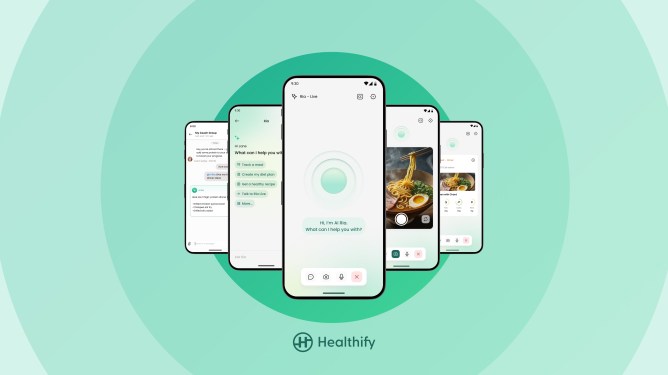
Health tracking companies are now leveraging new AI models to provide insights using both structured and unstructured data. Their goal is to create interfaces that make it easier for users to build habits around logging meals or workouts, supported by an ever-present AI assistant that can guide people in areas like nutrition and exercise.
Khosla-backed health startup Healthify launched a new version of its health assistant, Ria, on Tuesday. This assistant can converse live via voice and can use the camera to get input about your food. The startup is utilizing OpenAI’s technology to power this conversational mode. With this release, Ria supports more than 50 languages, including 14 Indian languages, and can handle mixed language input like Hinglish or Spanglish. While currently relying on OpenAI’s models, the company said it could use other models in the future if needed.
Through the new Ria, users can ask for a health overview for specific time frames like a day, week, or month, or get an overall summary. The app can pull data from different sources like fitness trackers, sleep trackers, or glucose monitors to provide insights about exercise, sleep, readiness, and glucose spikes, along with personalized suggestions.
Similar to Google Gemini’s Live Conversation mode, you can point the camera at food items to ask about their nutritional value and log them. Healthify also demonstrated using Ray-Ban Meta smart glasses to converse with Ria in real time and use the device’s camera to log food.
The startup believes users will feel more comfortable chatting in real time with an assistant. They can accomplish multiple tasks in one session, such as getting insights, generating an exercise plan, or logging goals. If you forget to log your food for the day, you can describe all your meals at once, and the assistant will log them for you.
Looking ahead, the company plans to make the conversational assistant a central part of user onboarding to gather more insights from unstructured conversations. This approach is similar to interfaces used by some new-age dating apps to create better matches.
Healthify is also creating a more persistent memory layer over OpenAI’s models so the assistant can remember long-term context around user preferences and health changes, enabling more personalized suggestions. Additionally, the assistant will be available during conversations with your coach or nutritionist to help pull data or answer questions when they are unavailable. Ria can also transcribe these calls for insights, and users or coaches can ask Ria for data during a call.
The company’s CEO, Tushar Vashisht, stated that the team trained Ria on years of conversational data between coaches and users to provide grounded and accurate advice.
Other apps have created ways for users to input food intake using voice, text, or images. Healthify believes its live conversation mode, data aggregation from various platforms, and AI trained on years of data give it a competitive edge. The company has also added a feature to access your photo gallery and automatically detect food photos, offering options to add meals you might have missed logging.
The company’s Chief Product Officer, Paritosh Kumar, said they are focusing on creating a health ecosystem of nutrition-driven data with other integrations and using AI to foster user accountability in health.
Healthify, which has over 45 million registered users and a few million active monthly users, is launching a new AI plan in the U.S. This plan includes the updated Ria assistant and meal planning for twenty dollars per month. Previously, the company had been testing various plans with text-based AI and certified nutrition coaches.
The company said it hopes to soon announce partnerships related to its GLP-1-aided weight loss programs. In the coming months, Healthify also plans to partner with health tracking device companies to integrate their data into Ria. CEO Tushar Vashisht mentioned the company may raise a new funding round in the near future, citing strong U.S. adoption and growth.