
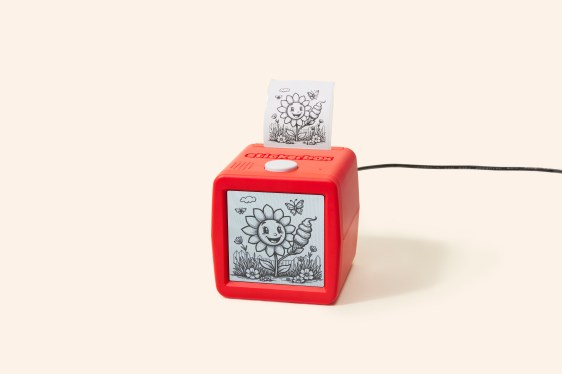
There is a new AI-powered toy for kids called Stickerbox, and before you groan, I am here to report that it is surprisingly fun. Stickerbox, a product from the Brooklyn-based startup Hapiko, is a voice-activated sticker printer. The device takes whatever creative idea you have in your head and transforms it into a printed sticker that you can then color, peel, and stick anywhere.
Before trying the device itself, I have to admit I came with a preconceived negative bias, as did my fellow tester, my daughter. Our initial reactions were similar. We thought an AI that prints stickers sounded like something we would rather design and print ourselves. After trying the review unit sent by the company, we were won over. I realized that Stickerbox could represent a new form of creative play, one that does not outsource a child’s imagination to an AI model as much as you might think.
The toy itself costs ninety-nine dollars and ninety-nine cents. It is a small, bright red box with a black-and-white screen and a big, white push-to-talk button on top. It ships with three rolls of paper, which equates to one hundred and eighty stickers, as well as a power cord and colored pencils. The box’s color scheme is reminiscent of the Etch A Sketch, which makes sense because Stickerbox feels like a modern spin on that concept. With an Etch A Sketch, you learn to control knobs to create an image. With Stickerbox, those knobs are replaced with voice commands you use to prompt the AI model.
Kids are not thinking about how to be better prompt engineers. They are just exploring their imagination and having fun seeing their ideas come to life. Any improvement in their prompting is a side effect. To set up the device, a parent will need to help. Much like adding a smart speaker to your Wi-Fi, you first connect to the Stickerbox’s Wi-Fi, then enter your home network information. The setup process only took a minute and went off without a hitch.
Using Stickerbox is simple. You push the button, describe an image out loud, then release the button to see your text appear on screen. An AI-generated image follows as the printer spits out a physical copy. There is a serendipity to the experience where you think of an idea and then hold it in your hand seconds later. The device’s thermal image printer requires no ink, and the paper is free of BPA and BPS, making it safe to use.
The printed sticker is easy to tear off and can then be colored with the included pencils or your own crayons and markers. This combines the exciting experience of thinking up new things to print with the more calming aspects of coloring, similar to a coloring book. This offered a healthy balance between using potentially addictive tech and then slowing down for a real-world activity. It also helped address potential boredom.
The more you use Stickerbox, the more you realize how complex your prompts can be. You do not just ask for a basic image like a magical unicorn. You can speak with long, train-of-thought commands, and the AI parses what you mean. This is particularly useful since kids do not always explain things in a straightforward way.
Hapiko, the company behind Stickerbox, was founded this year by CEO Arun Gupta and CTO Robert Whitney. The pair originally met while working at the e-commerce marketplace Grailed, where Whitney was director of engineering and Gupta was CEO. Before Grailed, Gupta founded and launched the Y Combinator-backed hardware sleep tracker WakeMate. Whitney had worked as the director of engineering at The New York Times Games division, helping it pivot from crosswords to a full gaming app. His later stint at Anthropic gave him a first-hand look at advances in AI technology.
However, it was Whitney’s experience as a father that inspired Stickerbox. When his son asked for a coloring page he did not have, he used ChatGPT to make a printable image of a tiger eating ice cream. His son was thrilled and soon returned to ask for a lizard riding a skateboard. Whitney saw a look of pure magic on his son’s face when he saw his idea come to life. The co-founders realized that while AI offered many novel experiences, few were made for kids. They asked what the right guardrails, methods, and products for children would be.
They realized kids have endless imagination and creativity, learning new things every day and developing new obsessions every week. They believe they are the first to put an image model inside a box designed for this purpose. Under the hood, Stickerbox uses a combination of AI models, including its own proprietary tech focused on making the device kid-safe. It will not respond to requests for harmful content like violence or sexual imagery, and it filters out swear words. If you try a more innocuous command, it may just print a random, vaguely related sticker. After failing to get a naughty result, most kids will likely go back to prompting for silly images.
The company wants to be a trusted brand for parents where you do not have to look over your child’s shoulder. For now, the company generates revenue from device sales, but it keeps the cost of restocking paper low. It is just five dollars and ninety-nine cents for three rolls, or one hundred and eighty stickers. A current promotion offers six rolls with every purchase. Over time, the team plans to explore adding premium features, such as a way to upload your own image or collaboration tools.
As a Wi-Fi-connected device, Stickerbox is regularly updated with new firmware and features. In tests, we were able to print some recognizable characters, but a recent update added new guardrails to guide kids toward more original designs. A soon-to-launch companion app will let you view past creations and save favorites, and it could ultimately host premium features. Stickerbox is backed by seven million dollars in funding from Maveron, Serena Williams’ Serena Ventures, the Allen Institute’s AI2 incubator, and various angels including Matt Brezina and product leaders from other consumer apps.