
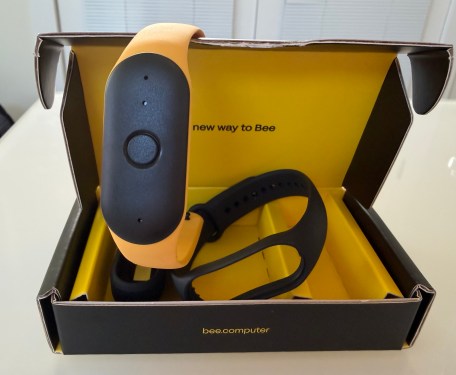
In early tests with a review unit of Bee, we found the device itself was easy to use. Turning recording on or off is just a press of a button. In the companion app, you can configure whether a double press bookmarks a section of the conversation, processes the current conversation, or both. You can also set whether a press and hold gesture lets you leave a voice note or chat with the AI assistant.
Like many other AI products and services, Bee can listen, record, and transcribe audio conversations. Where it differs is that instead of offering an overview or a raw transcript, it segments the audio into sections and summarizes each part. For instance, an interview might be segmented into sections like the introduction, product details, industry trends, and other topics.
Each section is tinted with a different background color for easier differentiation as you scroll. You can tap into an individual section to see the exact transcription.
It wasn’t immediately obvious how to label the speakers in the app. We learned we could tap on a segment to confirm if we were the speaker, but this fell short of other professional AI transcribers where each speaker could be labeled. In addition, Bee discards the audio after transcription, making it unsuitable for use cases where you need to play back the audio to ensure accuracy.
That said, Bee isn’t necessarily meant to be a work tool. Amazon sees this as an AI that can live alongside you as you go about your day. By integrating with Google’s services, Bee can tie a recorded conversation to a task. For instance, after meeting someone at a conference, it could suggest that you friend them on LinkedIn or research their product.
You can also leave yourself voice notes as an alternative to writing something down in a notes app. Another section in Bee’s app lets you look back at past days’ memories, while a “Grow” section will offer insights the more it learns about you. You can also confirm and add to a “facts” section about yourself. Amazon says it will be shipping more features for Bee in the year ahead.
Bee isn’t always listening by default. Instead, you’re meant to ask if you can record someone’s conversation, unless at a public event where recording is already expected. When you do record, a green light turns on, alerting others that the device is in use.
Bee’s sports band was a little flimsy. The band fell off twice while being worn, both times while just sitting and not moving much. We have not yet tested the clip-on pin, but it feels more sturdy.
Overall, the mobile app’s design is far ahead of the apps Amazon has built in-house, and it’s easy to use. But the premise that we need an AI specifically to record conversations to learn more about us is still largely untested. Is there a world where such devices make sense for consumers who aren’t recording in professional settings?
Plus, if AI listening devices go mainstream, there will also have to be a cultural shift in terms of what’s appropriate. Today, it’s somewhat looked down upon to record video of everyday people in public; similarly, it may be considered tasteless to record audio with an AI device if you don’t first ask permission. Not everyone will abide by that social contract, which could see people self-censoring their speech in public.
At CES, for instance, we were chatting with a rep at a booth. When they liked something I said about a competitor’s product, they joked, ‘Say that louder into my microphone,’ pointing to the already-recording AI device pinned to their shirt. It was an odd experience to realize that everything said in the real world could one day be “on the record,” whether you consented or not.
Bee’s traction—or lack thereof—will help Amazon determine if that’s a world consumers actually want.