
Twenty years ago, a Duke University professor, David R. Smith, used artificial composite materials called “metamaterials” to create a real-life invisibility cloak. While this early cloak had limited ability, only concealing objects from a single microwave wavelength, the advances in material science paved the way for new research in electromagnetism.
Today, a photonics startup named Neurophos, which originated from Duke University and an incubator run by Smith, is applying that research to address a critical challenge for AI labs and large-scale data centers: scaling computing power while managing energy consumption.
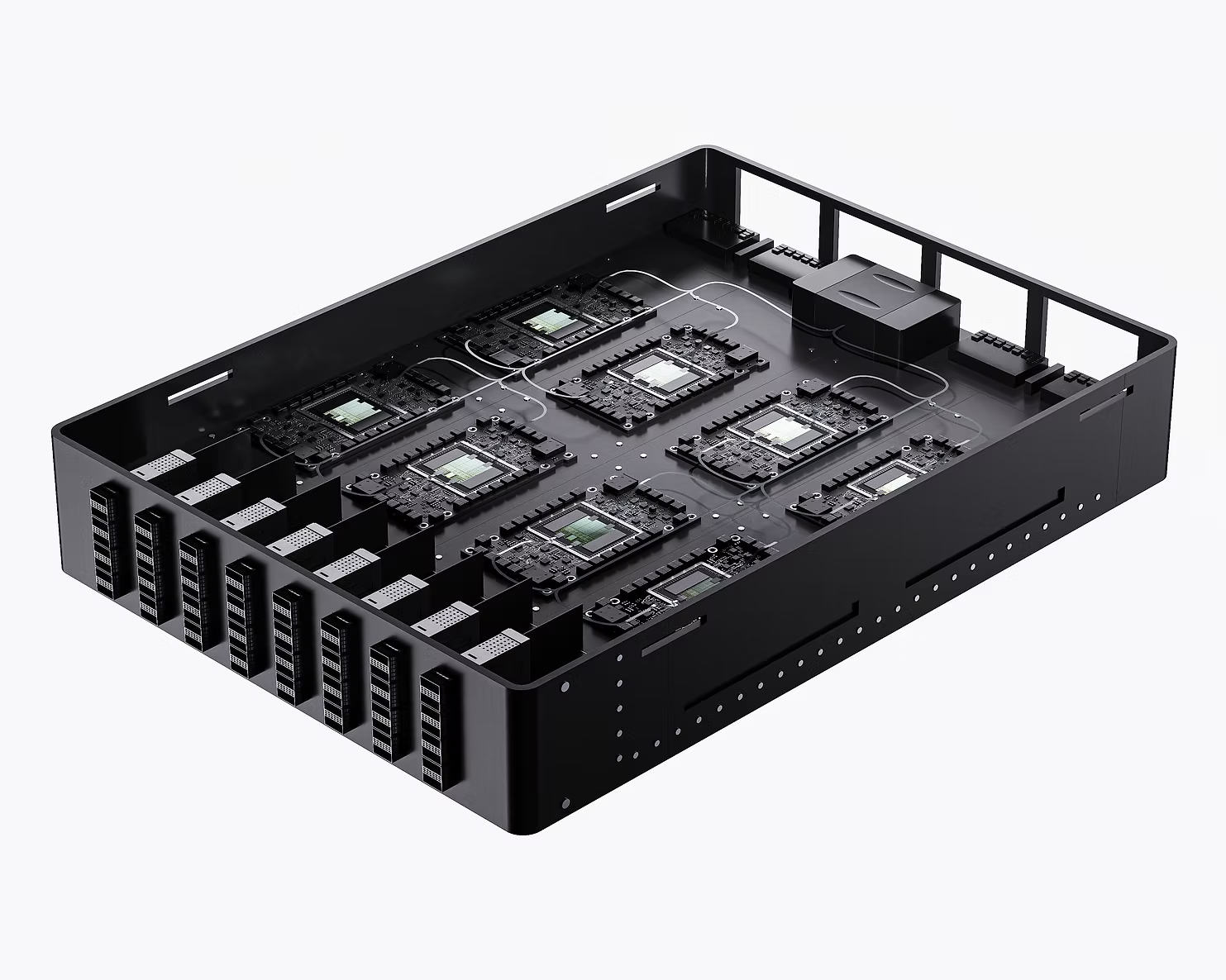
The company has developed a “metasurface modulator” with optical properties that allow it to function as a tensor core processor, performing the matrix vector multiplication essential to AI work, particularly inference tasks. Currently, this math is handled by specialized GPUs and TPUs using traditional silicon. Neurophos claims that by fitting thousands of these modulators onto a chip, its “optical processing unit” is significantly faster and far more energy-efficient for inference than the silicon GPUs widely used in data centers.
To fund its chip development, Neurophos has raised $110 million in a Series A round. The investment was led by Gates Frontier, with participation from Microsoft’s M12, Carbon Direct, Aramco Ventures, Bosch Ventures, Tectonic Ventures, Space Capital, and others.
Photonic chips are not a new concept. In theory, they offer higher performance than silicon because light generates less heat, travels faster, and is less affected by temperature and electromagnetic interference. However, optical components are typically larger than silicon parts, difficult to mass-produce, and require power-hungry converters to switch data between digital and analog formats.
Neurophos believes its metasurface solves these problems. The company states its optical transistor is about 10,000 times smaller than traditional versions. This small size allows thousands of units to be placed on a single chip, enabling many more simultaneous calculations and resulting in greater efficiency.
“When you shrink the optical transistor, you can do way more math in the optics domain before you have to do that conversion back to the electronics domain,” explained Dr. Patrick Bowen, CEO and co-founder of Neurophos. “If you want to go fast, you have to solve the energy efficiency problem first. Because if you’re going to take a chip and make it 100 times faster, it burns 100 times more power. So you get the privilege of going fast after you solve the energy efficiency problem.”
The company claims its optical processing unit dramatically outperforms current technology, citing that its chip can run at 56 GHz, delivering 235 Peta Operations per Second while consuming 675 watts. It compares this to Nvidia’s B200 AI GPU, which it states delivers 9 Peta Operations per Second at 1,000 watts.
Bowen says Neurophos has already signed multiple customers and that companies like Microsoft are evaluating its products closely. However, the startup is entering a market dominated by Nvidia and faces competition from other photonics companies. Neurophos is still years from production, expecting its first chips to reach the market by mid-2028.
Bowen remains confident, arguing that competitors’ progress is evolutionary, tied to advancements in silicon manufacturing. He believes Neurophos’s fundamental physics approach provides a revolutionary advantage, projecting a 50-fold lead in both energy efficiency and raw speed over contemporary technology by 2028.
To overcome traditional manufacturing hurdles for optical chips, Neurophos says its design can be produced using standard silicon foundry materials, tools, and processes.
The new funding will support the development of the company’s first integrated photonic compute system, including data center-ready modules, a full software stack, and early-access hardware. The company is also expanding with a new engineering site in San Francisco and growing its headquarters in Austin, Texas.
“Modern AI inference demands monumental amounts of power and compute,” said Dr. Marc Tremblay, corporate vice president at Microsoft. “We need a breakthrough in compute on par with the leaps we’ve seen in AI models themselves, which is what Neurophos’ technology and high-talent density team is developing.”