
Ford is launching a new battery storage business, pivoting its battery manufacturing capacity amid a shift away from large electric vehicles. Instead of canceling battery production plans, the company will use that capacity to build energy storage systems. These systems will utilize cheaper lithium iron phosphate (LFP) batteries to power data centers and help balance demand on the electric grid.
The company announced the battery storage systems will begin shipping in 2027, with a goal to build 20 gigawatt-hours of annual capacity. Ford will invest approximately $2 billion into this new venture over the next two years. This plan involves repurposing existing manufacturing capacity at its Kentucky factory. At this facility, Ford will produce LFP batteries using technology licensed from China’s CATL, along with battery energy storage system modules and 20-foot DC container systems.
Ford joins several other automakers operating or planning to enter the battery storage market. Tesla has sold battery storage products for a decade and deploys about 10 gigawatt-hours each quarter. General Motors also offers a suite of home and commercial battery storage products.
According to Lisa Drake, Ford’s vice president of technology platform programs and EV systems, the primary opportunity for this new business will be commercial grid customers. Data centers are a secondary focus, with some home storage products also expected. Drake explained that market research showed a clear customer preference for LFP prismatic container systems. She noted that Ford’s existing license to build that technology in the U.S., combined with over a century of large-scale manufacturing experience, made this move a natural fit.
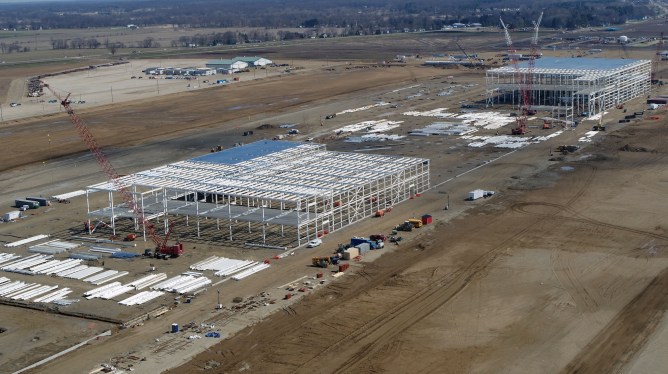
The company confirmed its BlueOval Battery Park Michigan in Marshall remains on track to begin LFP battery production in 2026. Those batteries, which also use CATL technology, are destined for Ford’s upcoming mid-sized electric truck. One adjustment at the Michigan factory is that it will also produce smaller Amp-hour cells for residential energy storage solutions.
The Michigan facility has seen several changes. In February 2023, Ford announced a $3.5 billion investment to build the factory for LFP batteries for its electric vehicles. Construction was abruptly halted in September 2023. Two months later, the company announced a scaled-back plan with a production capacity of 20 gigawatt-hours, which is about 43 percent smaller than originally intended.