
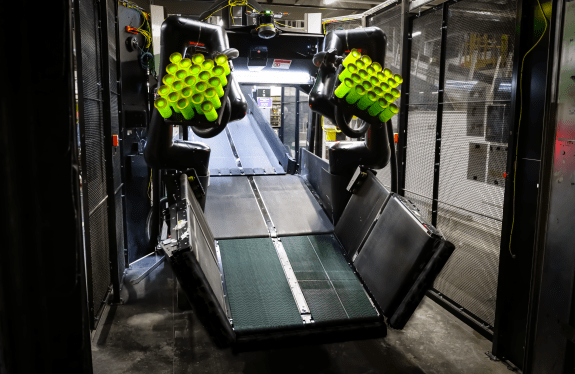
Automation is arriving in warehouses at a rapid pace. While some companies, such as Amazon, build their own robotic fleets internally, others seek automation technology from outside partners. FedEx has experimented with both approaches. The eighty-four billion dollar company has concluded that partnerships with robotics firms are the best strategy to keep pace with competitors in the automation race.
FedEx’s recent multi-year partnership with the SoftBank-owned robotics company Berkshire Grey demonstrates this strategy: rely on experts to create robots that can handle repetitive and dangerous human jobs. This non-exclusive partnership produced Scoop, a robot designed for bulk package unloading, which removes large bundles of multiple parcels from a truck simultaneously.
FedEx will begin a pilot program to roll out these robots in its warehouses later this year. Although the robots will not be deployed at every one of FedEx’s thousands of unloading doors, the company aims to scale the technology if the pilot is successful.
Stephanie Cook, director of advanced technology and innovation for robotics at FedEx, explained that bulk unloading is one of the most physically demanding and unpredictable jobs in their warehouses. She noted this is not the company’s first attempt to automate this task, but they previously struggled to find a suitable robot. Nothing available off-the-shelf met their needs. The collaboration with Berkshire Grey, a past partner, felt like a good fit, as developing a solution was recognized as a multi-year journey.
O.P. Skaaksrud, vice president of advanced technology and innovation at FedEx, stated that bulk unloading is an ideal role for a robot. While the bots must make decisions, the task is less granular than picking or searching for specific packages, making it a less complicated process to automate. Given the variety of packages, specialized single-pick robots are not fast enough for their mix.
Cook said the company prioritizes automating the most dangerous and physically demanding warehouse jobs first. These repetitive roles are generally better for automation, allowing employees to transition to less dangerous and more skilled work.
The Memphis-based company does develop some technology in-house, such as the FedEx SenseAware and SenseAware ID sensor systems for tracking packages. However, developing sensors and developing robotics are not the same. Skaaksrud explained that robotics capabilities are significantly more complex, and it is better and faster to partner with specialized companies to move forward. These partnerships benefit both FedEx and the companies involved.
Berkshire Grey is not FedEx’s only automation partnership. The company has secured several partnerships and conducted pilots in recent years to automate more of its processes inside and outside the warehouse. Within warehouses, FedEx works with Dexterity, a robotics startup specializing in robots with a human-like touch, and has a deal with Nimble, which builds fully autonomous warehouses.
Autonomous deliveries are another focus area. FedEx signed a pilot deal with autonomous trucking startup Aurora Innovation in 2021 to haul packages on defined routes in Texas. The partnership expanded in 2022 and has completed over thirty-two hundred autonomous loads. FedEx also partnered with Nuro, an autonomous last-mile delivery robot company, in 2021 on a long-term commitment. However, Nuro shifted to licensing its technology in 2025, and FedEx no longer works with them.
FedEx has also attempted in-house development for last-mile delivery with mixed results. The company developed and released the SameDay Bot in 2019, but the robots faced public resistance and were eventually discontinued. The company remains focused on the area.
Despite the push to automate, Skaaksrud and Cook emphasize that FedEx will not get ahead of itself. The company is not simply chasing every new piece of technology. Skaaksrud cautioned that focusing only on technology leads to failure, describing the process as a complex game of three-dimensional chess that requires solving many unglamorous components. The goal is to deploy productive technology that solves business problems.
The company is not concerned that its partnership strategy yields little proprietary hardware. Skaaksrud argued that hardware, like trucks, is just hardware; the network and intelligence behind the delivery system are what define FedEx.
While headlines may suggest a rush to automate everything, FedEx plans a calculated rollout. For Cook, the focus remains on warehouse employees. Technology must be designed to work alongside people, making jobs easier and safer.
Because the company focuses on areas with a clear return on investment, one area they are not currently pursuing is humanoid robots. Skaaksrud acknowledged the high hype and long-term potential of humanoids but pointed out the immense difficulty of orchestrating multiple humanoids in a dynamic, limited space. He stressed the importance of fit for purpose and understanding limitations.