
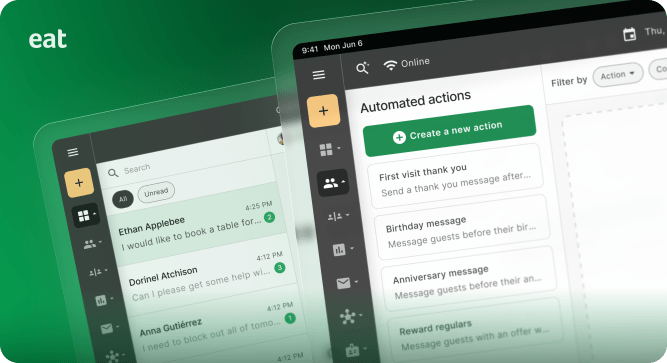
Dubai-based restaurant reservation startup Eat App aims to make India a focal point of its business. This strategy involves new fundraising, an acquisition, and a partnership with Swiggy. The company sells a solution to restaurants that aggregates reservation data and helps grow their business based on that information.
The company has raised $10 million in a Series B extension round led by PSG Equity through its portfolio company Zenchef SAS. This amount is larger than the startup’s original Series B round of $6 million in 2022. With this fundraiser, Eat App has now raised over $23 million in total funding.
Eat App has been operating for more than a decade and is present in over 92 countries, serving more than 5,000 restaurants with $12 million in annual recurring revenue. However, in the last 12 months, India has become a central focus as the company scaled to over 2,000 restaurants in the country.
India’s food service industry is set to reach over $85 billion by 2028, with dine-in making up more than half of that total. Restaurants often rely on walk-ins and separately manage reservations from sources like Zomato, Swiggy, and EazyDiner.
To achieve scale in India, Eat App acquired a rival called ReserveGo and also partnered with the recently listed food and grocery platform Swiggy to upsell its restaurant product.
ReserveGo was built by Vijayan Parthasarathy in 2022. Parthasarathy has a storied history in the restaurant reservation industry. Prior to ReserveGo, he built a similar platform called Inrestro in 2014, which was acquired by Times Internet-owned Dineout in 2015. In 2022, Swiggy acquired Dineout from Times Internet.
Eat App acquired ReserveGo in mid-2025, when it was serving over 1,000 restaurants. Parthasarathy stated that the platform has averaged handling 5 million reservations per month for the last 12 months without any downtime.
The partnership with Swiggy to market its product to restaurants has taken the startup’s total restaurant tally over 2,000, with over 8 million covers served until the year’s end through various platforms. For comparison, Swiggy’s Dineout platform alone catered to over 23.8 million covers in 2025.
An executive from Swiggy highlighted the exciting time for the restaurant industry in India and stated that access to Eat App’s technology and AI-driven tools will improve restaurant management and guest experiences. Swiggy, which was listed on the Indian markets last year, partnered with Eat App to bring a global solution for restaurants to grow their business.
Swiggy and Eat App market this solution as GroMax for India. It includes add-ons such as the ability to promote restaurants on Meta and Swiggy, apart from reservation management. While Swiggy doesn’t play a part in product development, its sales team provides input to Eat App about potential features for the market.
Before its India expansion, the United Arab Emirates was Eat App’s biggest market, followed by the U.S., the U.K., and Saudi Arabia. The CEO of Eat App noted strong similarities between the current opportunity in India and the early market dynamics seen in the Gulf region years ago, expressing hope to replicate that scaffolding and tech infrastructure success in India alongside local founders.
India presents a big opportunity in the restaurant space. However, for restaurants, the challenge is to attract customers using every channel possible and then collate those reservations in one place. Parthasarathy noted that while the top 200 restaurants in India are primarily accessible via reservations, for the next several thousand, it is more about capacity management across different channels.
Eat App’s growth faces obstacles. These include international competitors such as Seven Rooms, TableCheck, and OpenTable, along with local ones like PetPooja and Posist. Additionally, some restaurants rely solely on walk-ins or do not use aggregation software to gather data about their diners.
Several industry executives said that reservation aggregation software as a standalone product would not entice restaurant owners. Eat App will need to prove that its growth suite brings enough value to restaurants to succeed.