
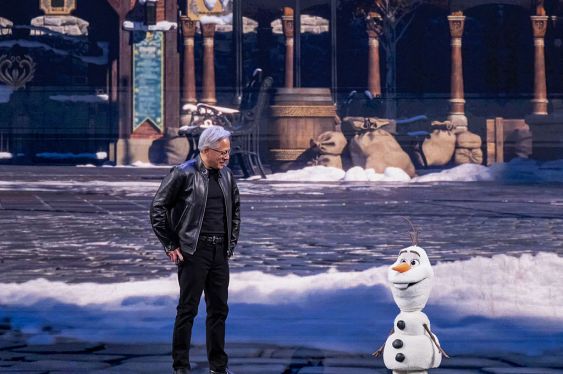
Nvidia’s GTC conference had everything. There were trillion dollar sales projections, graphics technology that can enhance video games, grand declarations that every company needs an OpenClaw strategy, and even a robot version of the beloved snowman Olaf from Disney’s “Frozen.”
On the latest episode of the Equity podcast, TechCrunch’s Kirsten Korosec, Sean O’Kane, and I recapped CEO Jensen Huang’s keynote and debated what it means for Nvidia’s future. A big part of our discussion focused on poor Olaf, whose microphone had to be turned off when he started rambling.
Even if the demo had gone flawlessly, Sean might still have had some reservations. He noted these presentations always focus on “the engineering challenges” and not the “really messy gray areas” on the social side. “But what happens when a kid kicks Olaf over?” Sean asked. “And then every other kid who sees Olaf get kicked or knocked over has their whole trip to Disney ruined and it ruins the brand?”
Read a preview of our conversation, edited for length and clarity, below.
Anthony: CEO Jensen Huang was basically saying that every company needs to have an OpenClaw strategy now. I think that is just a very grand statement that’s meant to be attention grabbing. It’s also interesting coming at this kind of transitional moment for OpenClaw. The founder has gone to OpenAI. So it’s now this open source project that potentially can flourish and evolve beyond its creator, or it could languish. If companies like Nvidia are investing a lot into it, then it’s more likely that it’ll continue to evolve. But it’ll be interesting to see a year from now, whether that looks like a prescient statement or everyone’s like, “Open what?”
Kirsten: In the case of Nvidia, it costs them nothing in the grand scheme of things to launch what they call NemoClaw, which is an open source project they built with the OpenClaw creator. But if they don’t do something, they have a lot to lose. So really that message to me, the way I translated it when Jensen was like, “Every enterprise needs to have an OpenClaw strategy,” it was, “Nvidia needs to have a solution or strategy for enterprises, because if it’s successful, it is another way or another pathway for Nvidia to be part of numerous other companies.” So doing nothing is a greater risk than doing something that doesn’t go anywhere.
Sean: The real question here is why have we not talked about what is clearly the end game for Nvidia, and the thing that is going to turn it into the first one hundred trillion dollar company, which is an Olaf robot.
Anthony: How could I forget?
Kirsten: Anthony, just go to the end of the two and a half hours to watch this. So, the Olaf robot comes out, and this is something that Jensen loves to do. He loves to have these demos and some of them go better than others. It is also to demonstrate Nvidia’s technology in robotics. I don’t know if Olaf was actually speaking in real time or if it was programmed. It felt a little programmed, or it had specific keywords that it used.
But the greatest part about it is that they had to cut its mic at the end because it just started rambling and speaking to the crowd. And then it went over to its little passageway and was slowly lowered. You could see it on the video. It was still talking, but no mic.
Sean: Now we just need to give this little robot a wheelbase. And I know the perfect founder who can provide it. I mean, these demos are always silly. I don’t want to get up on my soapbox, but this was an impressive demo up until the moment where it fell a little bit short.
This is another really good example of how robotics is a really interesting engineering problem and a really interesting physics problem and a really interesting integration problem. But this was presented as, in partnership with Disney, and it’s supposed to be the future of Disney parks. You’re going to be able to walk around and see Olaf from “Frozen” and take pictures of them.
But these efforts never consider, or certainly don’t put front and center in events like this, all the other things you have to consider when you roll stuff out like this. There’s a really good YouTuber, Defunctland, that did a really good video about the history of Disney trying to get these kinds of robotics into their park, these automatons.
The engineering challenges are really interesting and it’s fun to see that history, but it always comes back to the same question: Okay, but what happens when a kid kicks Olaf over? And then every other kid who sees Olaf get kicked or knocked over has their whole trip to Disney ruined and it ruins the brand?
There’s just so much on the social side of this. And that sounds silly, but this is the question that we’re kind of asking about humanoid robots, too. There’s so much hype about all this other stuff and we just don’t really hear as much conversation about the really messy gray areas on the social side of these things, and also just integrating them into people’s lives. We only ever really hear about the engineering challenges, which again, are really impressive.
Kirsten: I have a counterpoint and then we have to get to our next topic. This is a job creator, because Olaf will have to have a human babysitter in Disneyland, probably dressed up as Elsa or something else. You can imagine that actually, what we’re doing is creating jobs with this engineering experiment.