
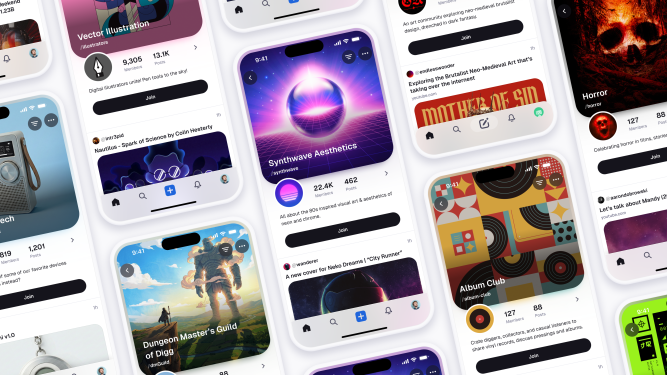
The reboot of the early-internet online community Digg, a one-time rival to Reddit, is moving forward. The company, which is now back under the ownership of its original founder Kevin Rose along with Reddit co-founder Alexis Ohanian, is launching its open beta to the public on Wednesday.
Similar to Reddit, the new Digg offers a website and mobile app where you can browse feeds featuring posts from across a selection of its communities and join other communities that align with your interests. There, you can post, comment, and upvote or “digg” the site’s content.
Originally a Web 2.0-era news aggregation site, Digg was once valued at 175 million dollars in 2008 but was ultimately outpaced by Reddit. That earlier version was split up in 2012, with its largest stake sold to the incubator Betaworks while LinkedIn and The Washington Post picked up other pieces. This iteration of Digg drew additional investment in 2016 but was later sold to a digital advertising company in 2018.
Meanwhile, Reddit continued to grow as a community-focused site that has since gone public and is currently generating additional revenue from content licensing agreements with major players in AI, including Google and OpenAI.
However, the rise of AI has presented an opportunity to rebuild Digg, Rose and Ohanian believe, leading them to acquire Digg last March through a leveraged buyout by True Ventures, Ohanian’s firm Seven Seven Six, Rose and Ohanian themselves, and the venture firm S32. The company has not disclosed its funding.
They are betting that AI can help to address some of the messiness and toxicity of today’s social media landscape. At the same time, social platforms will need a new set of tools to ensure they are not taken over by AI bots posing as people. Instead of simply offering verification checkmarks to designate trust, Digg will try out new technologies, like using zero-knowledge proofs to verify the people using its platform. It could also do other things, like require that people who join a product-focused community verify they actually own or use the product being discussed there.
As an example, a community for Oura ring owners could verify that everyone who posts has proven they own one of the smart rings. Rose suggests Digg could use signals acquired from mobile devices to help verify members, for instance, by identifying when Digg users attended a meetup in the same location.
Before today’s public beta launch, the site offered 21 more generalized communities like gaming, technology, and entertainment and was open to 67,000 users on an invite-only basis. Now, anyone will be able to join and start their own communities on nearly any topic, no matter how niche, which was a top request from beta testers. The community managers for these individual forums will be able to set their own rules, and their moderation logs will be shared publicly so members can see what decisions are being made.
The site has also been redesigned since its private beta, now offering a new sidebar where you can pin your favorite communities and a main feed optimized for visual elements. At launch, communities will only have one manager, but that will change in time as the company adds more features, including those to customize the look-and-feel and functionality of individual communities with integrations and other tools.
The company plans to listen to its community managers about what they need and build accordingly, and it has brought on some Reddit moderators as advisors. Although Reddit was built on the back of volunteer moderators, Digg aims to find a model that improves the moderator experience. Plans on this front have not been fleshed out yet.
In addition, the team is considering shifting its AI-created podcast about the interesting stories surfacing on Digg into a human-hosted version, as users have been requesting. Rose noted that the current team is small, giving them years of runway to find product-market fit.