
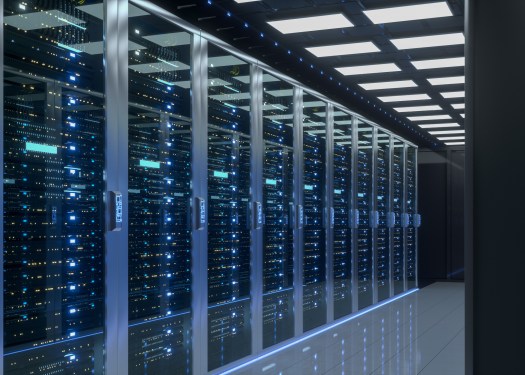
Data centers face a conundrum: how to power increasingly dense server racks using equipment that relies on century-old technology. Traditional transformers are bulky and hot, but a new generation of solid-state transformers promises to address both problems while making power management more flexible.
One solid-state transformer startup, DG Matrix, has raised $60 million in a Series A round. The round was led by Engine Ventures with participation from ABB, Cerberus Ventures, Chevron Technology Ventures, Clean Energy Ventures, Fine Structure Ventures, Helios Climate Ventures, MCJ, and Piedmont Capital.
The company also recently announced a deal to provide its Interport device to Exowatt, a startup building solar-plus-storage containers to supply data centers with 24/7 electricity.
The Interport device acts as a router for power. One unit can handle up to 2.4 megawatts of connections. For example, it could accumulate 600 kilowatts from solar panels and 600 kilowatts from grid-scale batteries to feed power to twelve server racks drawing 100 kilowatts each.
Because Interport can integrate electricity from a variety of sources, including large batteries, DG Matrix says it can eliminate uninterruptible power supplies and the supporting equipment. This consolidation significantly reduces the amount of space devoted to power conversion in a data center. Two four-by-thirty foot skids laden with power conversion equipment can be replaced by a single four-by-four foot Interport device.
By eliminating several devices, the company can boost the system’s overall efficiency. All the legacy devices chained together achieve about 82% to 90% efficiency, while Interport is 95% to 98% efficient. Reliability should also improve. Using only 10% to 15% of the components found in legacy systems leads to far greater reliability.
DG Matrix is in the process of rolling out initial units to customers. Its next product will be a sidecar to supply data center racks with power, building on the technology the company has already developed.
Currently, data centers represent about 90% of DG Matrix’s pipeline, with the remainder devoted to EV charging for fleets. The next step is to expand into building power and add more capacity to build micro- and mini-grids to support electrification projects in remote communities. There, Interport devices would orchestrate power from solar, wind, and batteries to provide round-the-clock electricity without a grid connection. This approach offers a more affordable alternative to building expensive transmission lines, helping to eliminate energy poverty.