
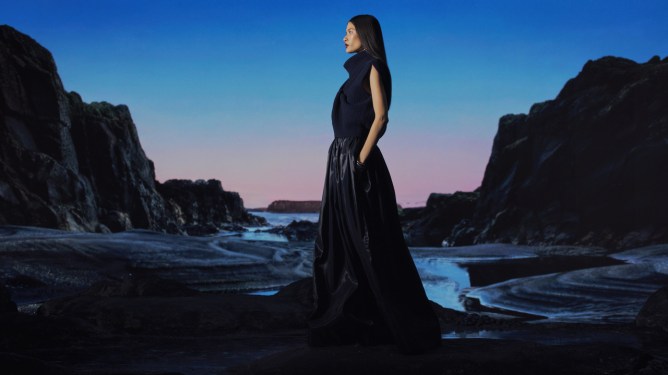
On Saturday, designer Kate Barton will unveil her latest collection at New York Fashion Week with a twist. Barton teamed up with Fiducia AI to create a multilingual AI agent, built with IBM Watsonx on IBM Cloud, to help guests identify pieces of the collection and try them on virtually.
Barton explained that technology is baked into how she thinks. She enjoys playing with the real and the unreal, and found the idea of using AI for set design to be a portal into the collection’s world, rather than using AI for its own sake. She told TechCrunch that today, tech is a tool for expanding the world around the clothes, how they are presented, and how people enter the story. The goal for this collection was to create a sense of curiosity.
Ganesh Harinath, the founder and CEO of Fiducia AI, said his company used IBM watsonx, IBM Cloud, and IBM Cloud Object Storage to help pull off Barton’s presentation. It was a production-grade activation with a Visual AI lens that detects pieces from Barton’s new collection. It can answer questions in any language via voice and text and offers photorealistic virtual reality try-ons. Harinath noted that the hardest work wasn’t model tuning; it was orchestration.
This isn’t the first time Barton has put a technological spin on her fashion. Last season, she also experimented with AI models in collaboration with Fiducia AI.
At fashion week, there was chatter about which brands would be using technology and artificial intelligence. Barton thinks many brands are using AI, though quietly, mainly in operations. She suggested that fewer are using it publicly because of the potential reputational risk. She compared it to the early days when many big fashion names were nervous about starting websites, which later became inevitable.
Harinath added that, though many brands are experimenting with AI, much of its deployment remains at the surface level, such as chatbots, content generation, and internal productivity tools. But Barton sees a future of better prototyping, better visualization, smarter production decisions, and more immersive ways to experience fashion, without replacing the humans who actually make it worth wearing. She believes change will only come with more clarity, clear discourse, clear licensing, clear credit, and a shared understanding that human creativity is not an annoying overhead cost.
Barton stated that if the technology is used to erase people, she is not into it, adding that audiences are smarter than we think and can tell the difference between invention and avoidance.
Despite the tension, AI is becoming more routine, and there will come a day when shows like Barton’s are just part of the norm. Harinath thinks AI in fashion will be normalized by 2028, and he sees it becoming embedded into the operational core of retail. He said most of this technology already exists, and the differentiator now is assembling the right partners and building teams that can operationalize it responsibly.
Dee Waddell, Global Head of Consumer, Travel and Transportation Industries at IBM Consulting, agreed. Waddell told TechCrunch that when inspiration, product intelligence, and engagement are connected in real time, AI moves from being a feature to becoming a growth engine that drives measurable competitive advantage.
But until then, there is this show. Barton concluded that the most exciting future for fashion is not automated fashion. It is fashion that uses new tools to heighten craft, deepen storytelling, and bring more people into the experience, without flattening the people who make it.