
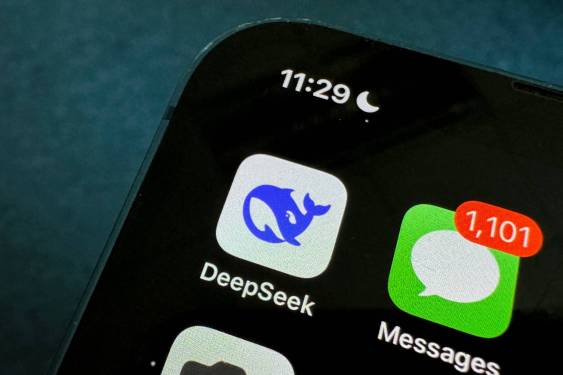
DeepSeek has gone viral. The Chinese AI lab broke into the mainstream consciousness this week after its chatbot app rose to the top of the Apple App Store charts and Google Play as well. DeepSeek’s AI models, which were trained using compute-efficient techniques, have led Wall Street analysts and technologists to question whether the United States can maintain its lead in the AI race and whether the demand for AI chips will sustain.
But where did DeepSeek come from, and how did it rise to international fame so quickly?
DeepSeek is backed by High-Flyer Capital Management, a Chinese quantitative hedge fund that uses AI to inform its trading decisions. AI enthusiast Liang Wenfeng co-founded High-Flyer in 2015. Wenfeng, who reportedly began dabbling in trading while a student at Zhejiang University, launched High-Flyer Capital Management as a hedge fund in 2019 focused on developing and deploying AI algorithms.
In 2023, High-Flyer started DeepSeek as a lab dedicated to researching AI tools separate from its financial business. With High-Flyer as one of its investors, the lab spun off into its own company, also called DeepSeek. From day one, DeepSeek built its own data center clusters for model training. But like other AI companies in China, DeepSeek has been affected by United States export bans on hardware. To train one of its more recent models, the company was forced to use Nvidia H800 chips, a less powerful version of a chip, the H100, available to United States companies.
DeepSeek’s technical team is said to skew young. The company reportedly aggressively recruits doctorate AI researchers from top Chinese universities. DeepSeek also hires people without any computer science background to help its tech better understand a wide range of subjects, per The New York Times.
DeepSeek unveiled its first set of models, DeepSeek Coder, DeepSeek LLM, and DeepSeek Chat, in November 2023. But it was not until last spring, when the startup released its next generation DeepSeek-V2 family of models, that the AI industry started to take notice. DeepSeek-V2, a general purpose text and image analyzing system, performed well in various AI benchmarks and was far cheaper to run than comparable models at the time. It forced DeepSeek’s domestic competition, including ByteDance and Alibaba, to cut the usage prices for some of their models and make others completely free.
DeepSeek-V3, launched in December 2024, only added to DeepSeek’s notoriety. According to DeepSeek’s internal benchmark testing, DeepSeek V3 outperforms both downloadable, openly available models like Meta’s Llama and closed models that can only be accessed through an API, like OpenAI’s GPT-4o.
Equally impressive is DeepSeek’s R1 reasoning model. Released in January, DeepSeek claims R1 performs as well as OpenAI’s o1 model on key benchmarks. Being a reasoning model, R1 effectively fact checks itself, which helps it to avoid some of the pitfalls that normally trip up models. Reasoning models take a little longer, usually seconds to minutes longer, to arrive at solutions compared to a typical non reasoning model. The upside is that they tend to be more reliable in domains such as physics, science, and math.
There is a downside to R1, DeepSeek V3, and DeepSeek’s other models, however. Being Chinese developed AI, they are subject to benchmarking by China’s internet regulator to ensure that its responses embody core socialist values. In DeepSeek’s chatbot app, for example, R1 will not answer questions about Tiananmen Square or Taiwan’s autonomy.
In March, DeepSeek surpassed sixteen point five million visits. For March, DeepSeek is in second place, despite seeing traffic drop twenty five percent from where it was in February, based on daily visits, David Carr, editor at Similarweb, told TechCrunch. It still pales in comparison to ChatGPT, which surged past five hundred million weekly active users in March.
In May, DeepSeek released an updated version of its R1 reasoning AI model on the developer platform Hugging Face. DeepSeek unveiled a new experimental model called V3.2-exp in September, designed to have dramatically lower inference costs when used in long context operations.
If DeepSeek has a business model, it is not clear what that model is, exactly. The company prices its products and services well below market value and gives others away for free. It is also not taking investor money, despite a ton of venture capital interest.
The way DeepSeek tells it, efficiency breakthroughs have enabled it to maintain extreme cost competitiveness. Some experts dispute the figures the company has supplied, however. Whatever the case may be, developers have taken to DeepSeek’s models, which are not open source as the phrase is commonly understood but are available under permissive licenses that allow for commercial use. According to Clem Delangue, the chief executive officer of Hugging Face, one of the platforms hosting DeepSeek’s models, developers on Hugging Face have created over five hundred derivative models of R1 that have racked up two point five million downloads combined.
DeepSeek’s success against larger and more established rivals has been described as upending AI and over hyped. The company’s success was at least in part responsible for causing Nvidia’s stock price to drop by eighteen percent in January and for eliciting a public response from OpenAI chief executive officer Sam Altman.
In March, United States Commerce department bureaus told staffers that DeepSeek will be banned on their government devices, according to Reuters. Microsoft announced that DeepSeek is available on its Azure AI Foundry service, Microsoft’s platform that brings together AI services for enterprises under a single banner. When asked about DeepSeek’s impact on Meta’s AI spending during its first quarter earnings call, chief executive officer Mark Zuckerberg said spending on AI infrastructure will continue to be a strategic advantage for Meta.
In March, OpenAI called DeepSeek state subsidized and state controlled and recommends that the United States government consider banning models from DeepSeek. During Nvidia’s fourth quarter earnings call, chief executive officer Jensen Huang emphasized DeepSeek’s excellent innovation, saying that it and other reasoning models are great for Nvidia because they need so much more compute.
At the same time, some companies are banning DeepSeek, and so are entire countries and governments, including South Korea. New York state also banned DeepSeek from being used on government devices. In May, Microsoft vice chairman and president Brad Smith said in a Senate hearing that Microsoft employees are not allowed to use DeepSeek due to data security and propaganda concerns.
As for what DeepSeek’s future might hold, it is not clear. Improved models are a given. But the United States government appears to be growing wary of what it perceives as harmful foreign influence. In March, The Wall Street Journal reported that the United States will likely ban DeepSeek on government devices.