
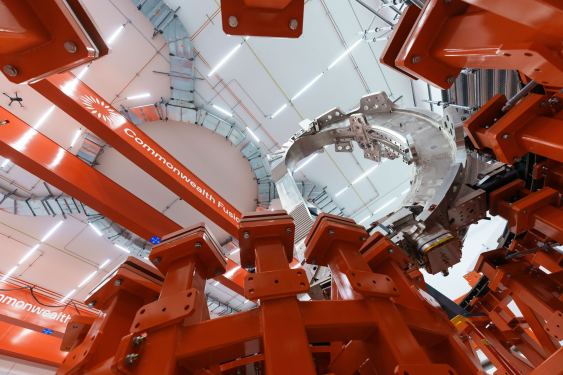
Commonwealth Fusion Systems announced a major milestone at CES 2026. The company has installed the first magnet in its Sparc fusion reactor, a demonstration device it aims to activate next year. This magnet is the initial piece of a set of 18 that will ultimately form a doughnut-like shape. Together, they will generate a powerful magnetic field designed to confine and compress superheated plasma. The goal is for that plasma to release more energy than is required to create it.
After many decades of anticipation, fusion power seems closer than ever. Commonwealth Fusion Systems and its competitors are now in a race to deliver the first electricity to the power grid in the early 2030s. Success would unlock a source of nearly limitless clean energy from a facility resembling a traditional power plant.
Key components for Sparc’s magnets are finished, and the company expects to install all 18 by the end of the summer. According to Bob Mumgaard, co-founder and CEO of CFS, the installation will proceed rapidly throughout the first half of the year as they assemble this revolutionary technology.
Each of these D-shaped magnets weighs 24 tons and can generate a magnetic field of 20 tesla. That is roughly thirteen times stronger than the field of a typical MRI machine. Mumgaard described it as the type of magnet that could lift an aircraft carrier. Once installed, the magnets will stand upright on a massive 24-foot wide, 75-ton stainless steel ring called a cryostat, which was positioned last March.
To achieve their immense strength, the magnets will be cooled to -253 degrees Celsius. This extreme cold allows them to safely conduct over 30,000 amps of current. Meanwhile, inside the reactor’s core, the plasma will burn at temperatures exceeding 100 million degrees Celsius.
To prepare for Sparc’s activation, CFS is collaborating with Nvidia and Siemens to create a digital twin of the reactor. Siemens provides the design software, and data will feed into Nvidia’s Omniverse platform. While CFS has run many isolated simulations before, this digital twin will exist alongside the physical reactor for constant comparison. This allows the team to run virtual experiments and adjust parameters digitally before applying changes to the real machine, accelerating the learning process.
Developing Sparc represents a significant financial undertaking. To date, CFS has raised nearly $3 billion. This includes an $863 million funding round last August with investments from Nvidia, Google, and many others. The company’s first commercial power plant, named Arc, will be a first-of-its-kind project and is estimated to cost several billion more dollars.
Mumgaard believes that digital twins and artificial intelligence will be crucial tools. He hopes this technology will help deliver fusion power to the grid more quickly, emphasizing the urgency of making this clean energy source a reality.