
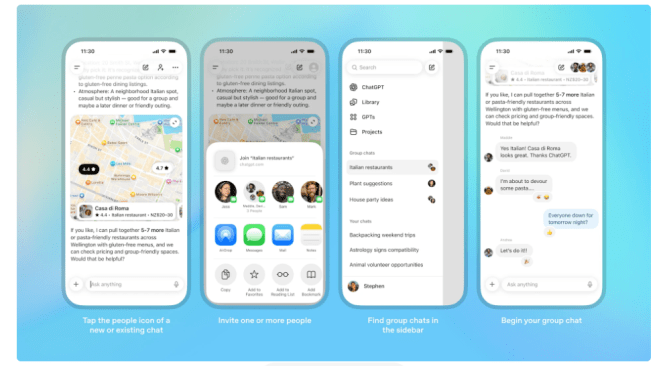
OpenAI introduced a new group chat feature for ChatGPT on Thursday. This feature is currently being tested in select regions, including Japan, New Zealand, South Korea, and Taiwan. It allows users to collaborate directly within the application.
The group chat is available to Free, Plus, and Team users on both mobile and web platforms. OpenAI describes this pilot as a small first step toward creating a more shared experience in the app. The company aims to explore how people use group conversations in ChatGPT. This announcement follows earlier reports that OpenAI had been testing a direct-message-style tool.
Early users will be invited to provide feedback, which will help shape how the feature eventually expands to more regions and offerings. According to OpenAI, private chats and personal ChatGPT memory remain completely private. Group chats are invitation-only, and members can leave at any time. Most participants can remove others, though the group’s creator can only leave voluntarily. For users under 18, content is filtered with extra safeguards and parental controls in place.
Starting a group chat is straightforward. Users can tap the people icon and add participants either directly or by sharing a link. Groups can include one to twenty people. If you add someone to an existing chat, a new group is created, leaving the original conversation unchanged. Each group has a short profile, and all chats are organized in a labeled sidebar for easy access.
Group chats function like regular ChatGPT conversations but with multiple people joining in. A model called GPT-5.1 Auto handles responses and comes loaded with features such as search, image generation, file uploads, and dictation. In group chats, ChatGPT’s usage limits, which restrict how many AI responses users can receive per hour, only count when ChatGPT responds. Messages between human participants do not count toward these limits.
ChatGPT has learned new social skills for group chats, knowing when to jump in and when to stay quiet. You can tag ChatGPT to get it to respond. It can also react with emojis and use profile photos to create personalized images for the conversation.
The group chat feature represents the latest step in OpenAI’s gradual transformation from a simple AI assistant into something resembling a social platform. In late September, the company launched Sora 2, a standalone social media app with a TikTok-style feed for sharing AI-generated videos. That app includes algorithmic recommendations based on user activity and location, parental controls, and direct messaging capabilities.