
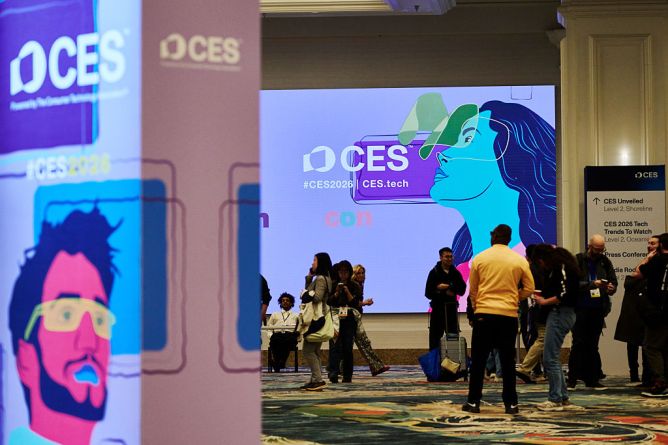
The biggest obstacle to scaling robots might surprise you. One more comment from Boston Dynamics CEO Robert Playter is worth including here. Playter was asked on stage at CES 2026 about the limiting factors to scaling robots in the real world. While technology is part of it, Playter noted that “people’s attitudes” are another major obstacle. He explained that it takes two to three years for customers to get used to having robots in their facility before they are ready to start expanding. He described this as a cultural piece to the technology adoption that few discuss. Mikell Taylor, director of robotics strategy at General Motors, agreed, adding that the deliberate user experience process is fascinating and must be part of product design and deployment planning. She noted that many companies struggle by not accounting for this, stating, “You can’t go from zero to humanoid.”
Boston Dynamics CEO Robert Playter believes the robotics industry is evolving out of its niche stage and into scale. Playter made these comments on a panel at CES 2026. He reflected that for thirty years, robotics has been dominated by prototypes and YouTube videos, but now adoption is actually starting to happen. Playter noted that Boston Dynamics, majority-owned by Hyundai, has over 2,000 Spot robot dogs with customers in factory settings. He highlighted the growing ecosystem of partner companies and component providers wanting to enter the robotics business, which he says is required to scale the industry.
Hyundai does not hold a press conference at CES every year, but when it does, you can expect news. The Hyundai Motor Group is back at CES 2026 with a press conference scheduled for 1 pm PT on January 5. The event will be streamed on the company’s YouTube channel. Expectations are for a heavy focus on robotics and AI. Boston Dynamics, which Hyundai owns, is expected to publicly debut its new Atlas robot at CES for the first time.
It is time to test some Chinese EVs. Chinese EV giant Geely has brought journalists and auto industry folks to the Las Vegas Motor Speedway to get seat time with nearly a dozen cars from its portfolio. Since these cars are not road-legal in the U.S., the testing is happening on the speedway grounds. Many of these EVs have received high praise and have U.S. automakers on high alert.
Chinese lidar maker Hesai announced at CES 2026 that it plans to double its production capacity from 2 million units to 4 million units this year. The company cited accelerating demand in the automotive and robotics industries as the reason for doubling its target. This represents a significant increase from the more than 1 million units Hesai produced in 2025. This expansion comes amid continued market consolidation, including the Chapter 11 bankruptcy of leading U.S. lidar-maker Luminar.
Boston-based Teradar, which recently raised $150 million, is showing off its first flagship terahertz sensor at CES 2026. The startup pitches the product as the first long-range, high-resolution sensor of its kind designed for high performance in any weather, aiming to fill a gap left by legacy radar and lidar sensors.
In the early hours at CES 2026, self-driving truck company Kodiak AI announced it is working with automotive supplier Bosch to develop a system of hardware and software that can give standard big rigs autonomous driving capabilities. This collaboration is a key step for Kodiak as it tries to scale from a handful of driverless trucks to dozens or even hundreds.
The Mentoring2 is a smart ring that helps you visualize your stress in real-time. It works with an app that measures metrics like temperature, movement, sweating, and heart rate through an algorithm. A companion mobile app shows your stats and reminds you to take a break. The concept comes from a team in Japan aiming to combat workaholic culture, where people often ignore their body’s stress signals.
Google is showing off a series of new Gemini features coming to its Google TV platform. The features will allow viewers to deep-dive into topics via AI, search for and reimagine personal photos and videos with AI, and control the TV using voice commands instead of navigating complex settings.
Casio launched an AI pet last year called Moflin. Now, there is a new AI pet: a panda called An’An from Mind With Heart Robotics. The company is showing off the panda at CES 2026. It has more than 10 sensor suites to respond to touch and is designed for elderly care, learning behavioral patterns including voice. There is also a B2B version for health institutes.
A significant portion of CES is about TVs, and they keep getting thinner. For instance, LG is showing off a new Wallpaper OLED TV that is just 9mm thick. For perspective, an Apple iPhone 16 is slightly thinner at 7.8mm.
Withings, the French tech company that introduced the first connected scale in 2009, has launched the Body Scan 2, described as a home longevity station. This new smart scale features a tempered glass surface and a retractable handle with a display. It can capture over 60 biomarkers in around 90 seconds, providing notifications about hypertension risk—a first for a home scale—and assessments of cardiac efficiency and metabolic health. The metrics sync with a companion app and Apple Health. The scale will be available in the second quarter of 2026 for $599.95.