
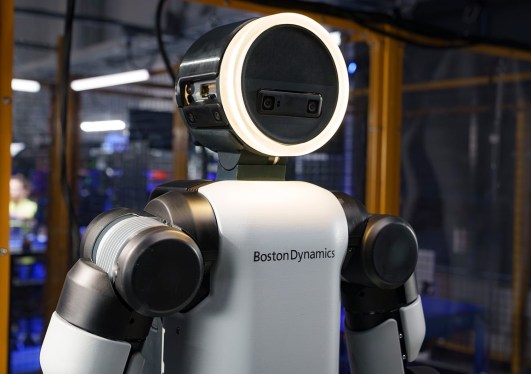
Robotics company Boston Dynamics announced a strategic partnership with Google’s AI research lab on Monday. The goal is to accelerate the development of its next-generation humanoid robot, Atlas, and make it act more naturally around people.
The partnership was revealed during a Hyundai press conference at CES 2026. It focuses on robotics research that will utilize Google DeepMind’s AI foundation models. Boston Dynamics’ Atlas robot will serve as the first test case for this collaboration, according to Carolina Parada, senior director of robotics at Google DeepMind. Parada stated that the teams aim to integrate cutting-edge AI foundation models with the new Atlas robots to develop the world’s most advanced robot foundation model and achieve true general-purpose humanoid capabilities.
This alliance follows Google DeepMind’s announcement less than a year ago of new AI models called Gemini Robotics. These models are designed to enable robots to perceive, reason, use tools, and interact with humans. Gemini Robotics is built on a large-scale multimodal generative AI model and was trained to generalize behavior across various robotics hardware.
Boston Dynamics, along with its majority owner Hyundai Motor Group, brings real-world scaling intent to this partnership. The company already has commercial products like the Spot quadruped in use in over forty countries. Its warehouse robot, Stretch, has unloaded more than twenty million boxes globally since launching in 2023. Now, the focus is on the next generation, starting with the humanoid Atlas, which is already in production and headed to a Hyundai factory.
A prototype of the Atlas robot walked on stage during the press conference, demonstrating its mobility. However, as Alberto Rodriguez, director of Atlas behavior at Boston Dynamics, explained, turning Atlas into a viable product requires more than just athletic performance. For humanoids to deliver on their promise, they must be able to interact with people naturally. Rodriguez and his team believe recent advancements in AI have created a clear path to achieving these essential capabilities.