
South Korea’s major defense companies have accumulated approximately 69 billion dollars in order backlogs as of late 2024. The country is accelerating its investment in advanced weapons systems and expanding its defense partnerships, particularly with Europe. Following the new EU-South Korea Security and Defence Partnership in 2024 and growing exports of vehicles and artillery, South Korea has become the second-largest arms supplier to European NATO members.
Despite this enormous industrial footprint, remarkably few startups have emerged to match or challenge the established companies. The country’s defense-tech startup scene is still nascent, exposing a wide gap between Korea’s manufacturing strength and its early-stage innovation.
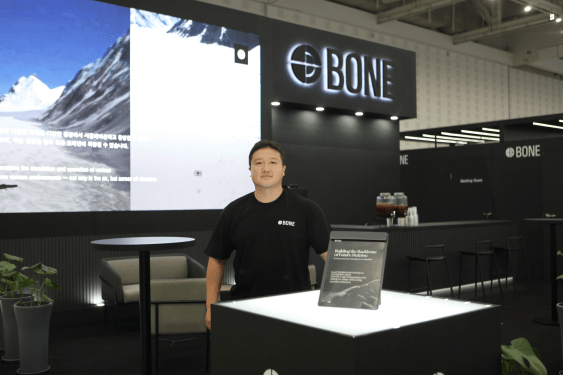
Bone AI, a new startup based in Seoul and Palo Alto, California, launched earlier this year with an ambitious plan to build a fully unified AI platform that ties together software, hardware, and manufacturing. The company develops next-generation autonomous air, ground, and marine vehicles for defense and government clients, focusing largely on business-to-government contracts. While it ultimately aims to operate all three types of systems, Bone is starting with its defense-focused aerial drones, which are designed for missions such as logistics support, wildfire detection, and anti-drone defense.
The company was founded by DK Lee, who also co-founded MarqVision. It has raised a 12 million dollar seed round led by Third Prime with participation from Kolon Group, a South Korean strategic investor with expertise in advanced materials and manufacturing. Kolon is considered an ideal strategic partner for Bone, which operates across AI, robotics, and next-generation manufacturing.
The startup is already generating revenue, landing a seven-figure business-to-government contract and pulling in 3 million dollars in its first year of operation. Bone has also been selected as a winner in a South Korean government-backed end-to-end logistics program that will deploy unmanned aerial and ground vehicles powered by its autonomy stack.
When asked how a company less than a year old is already securing contracts, Lee explained that Bone acquired a South Korean drone company called D-Makers, and its intellectual property, just six months after launch. Originally focused on AI models for robotics, Bone is now integrating its existing AI division with the newly acquired company, and more acquisitions are planned.
Lee personally committed more than ten percent of the funding round, approximately 1.5 million dollars. He stated that this was important to show both investors and his team that he is fully invested, financially and emotionally, in the mission.
Bone is Lee’s second venture. His experience co-founding MarqVision gave him insight into building and scaling AI products worldwide, but it also convinced him that the next frontier of AI is physical. After leaving MarqVision, he started from zero, attending robotics conferences and connecting with engineers to build his new company.
Lee frames Bone AI not just as a defense tech company but as a physical AI firm. It aims to bring together advanced AI simulation, autonomy algorithms, embedded engineering, hardware design, and large-scale manufacturing under one roof. He observed that AI and hardware were advancing in isolation, with no one building the connective tissue that allows intelligent machines to exist at scale.
Lee points to South Korea’s track record of building global hardware manufacturing powerhouses like Hyundai, Samsung, and LG. He believes this is why more drone and small-robotics companies should emerge there, and why Korea is fully capable of supporting them. The mission at Bone is to build the supply chain for physical AI within South Korea, and then expand that capability to the US, Europe, and other allied countries.
While companies like Anduril in the US and Helsing in Europe have become household names with high valuations, Asia has yet to see the same level of adoption. An investor from Third Prime noted that as economies focus on reindustrialization, Bone sits at the intersection of sovereign AI, multipolarity, and reindustrialization. South Korea has high-quality, cost-competitive hardware manufacturing across multiple sectors such as heavy industry, shipbuilding, cars, and semiconductors. Many niche hardware players exist but have not received significant venture funding. Bone employs a strong buy versus build strategy to acquire and integrate these assets, accelerating product maturity and commercial traction.