
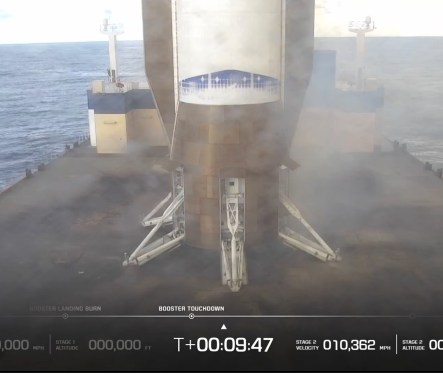
Blue Origin, the space company founded by Jeff Bezos, has successfully landed the booster of its New Glenn rocket on a drone ship in the Atlantic Ocean. This achievement occurred on only the second launch attempt, making Blue Origin the second company to accomplish such a feat after Elon Musk’s SpaceX. This milestone is a critical step toward establishing the new rocket as a viable option for sending large payloads to space, the Moon, and beyond.
The launch on Thursday involved more than just the landing. Approximately 34 minutes after liftoff, the rocket’s upper stage successfully deployed its first commercial payload. This payload consisted of two NASA spacecraft that are now on their way to Mars to study the planet’s atmosphere. These dual successes are remarkable for only the second flight of such a massive rocket system and position Blue Origin to potentially compete with SpaceX, which currently dominates the global launch market.
The path to this second launch was not without challenges. Following the first launch in January, Blue Origin experienced multiple delays. The company had initially hoped for a second attempt in the spring but pushed the date back several times. The rocket finally reached the launch pad on Sunday, but further delays were caused by weather and solar storms. The successful launch from Cape Canaveral, Florida, occurred on Thursday afternoon.
About four minutes into the flight, the second stage separated and continued into space while the New Glenn booster began its return to Earth. Roughly ten minutes after liftoff, the 189-foot-tall booster touched down safely on the floating platform. This landing was a significant redemption after the booster from the first flight in January exploded before it could land. Blue Origin worked with the Federal Aviation Administration to identify issues and implement fixes, expressing confidence that the second attempt would be successful.
The ability to land and recover a booster is a fundamental step in creating a reusable rocket system, which dramatically lowers costs for customers. This is a capability that SpaceX has already mastered. The next challenge for Blue Origin is to demonstrate that it can refurbish a flown booster and launch it again.
These capabilities are crucial for both commercial and government missions. Blue Origin has long been focused on lunar missions and is currently developing a lunar lander. SpaceX is also developing a lunar lander with its Starship rocket. The government has urged both companies to accelerate their programs, with NASA recently criticizing SpaceX for its pace. The CEO of Blue Origin has stated his company will do everything possible to help NASA return to the Moon faster. Successfully proving the full capabilities of the New Glenn rocket is essential to that goal, and Thursday’s launch was a major stride forward.