
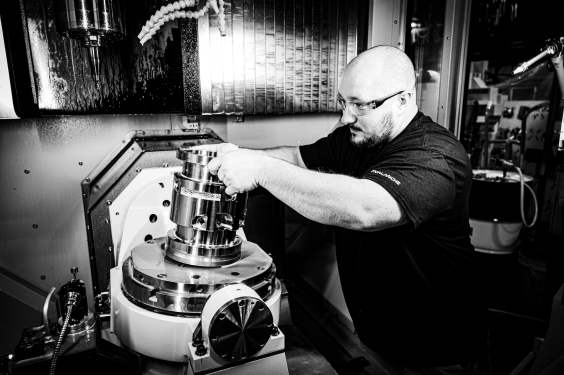
Nuclear fusion often brings to mind images of massive reactors or banks of large lasers. Avalanche co-founder and CEO Robin Langtry believes smaller is better. For several years, Langtry and his team have been developing what is essentially a desktop version of nuclear fusion. He explains that the small size allows them to learn and iterate quickly.
Fusion power promises to supply the world with vast amounts of clean heat and electricity, but researchers must first solve significant challenges. At its core, fusion seeks to harness the power of the Sun. Startups must figure out how to heat and compress plasma long enough for atoms to fuse and release energy. The industry is famously unforgiving, with challenging physics, cutting-edge materials science, and enormous power requirements. Precision machining is essential, and the typical large scale often prevents rapid experimentation.
While companies like Commonwealth Fusion Systems use large magnets in a doughnut-shaped tokamak, and others compress fuel pellets with powerful lasers, Avalanche takes a different approach. It uses extremely high-voltage electric current to draw plasma particles into an orbit around an electrode, assisted by some magnets to maintain order. As the orbit tightens and the plasma accelerates, the particles collide and fuse.
This method has attracted investors. Avalanche recently raised an additional 29 million dollars in a round led by R.A. Capital Management, with participation from several other venture firms. To date, the company has raised 80 million dollars from investors, a relatively modest sum in the fusion world where other companies have raised hundreds of millions or even billions.
Langtry’s time at the space tech company Blue Origin influenced Avalanche’s strategy. He describes adopting a rapid iteration approach similar to that used in new space companies. Building smaller has allowed Avalanche to speed up its development, testing changes to its devices sometimes twice a week, a pace that would be difficult and costly with a large reactor.
Currently, Avalanche’s reactor is only nine centimeters in diameter. However, Langtry says a new version will grow to 25 centimeters and is expected to produce about one megawatt. This increase should significantly improve plasma confinement time, moving the company closer to achieving a Q greater than one, where the device produces more power than it consumes.
These experiments will be conducted at Avalanche’s commercial testing facility, FusionWERX, which is also rented out to competitors. By 2027, the site will be licensed to handle tritium, a key hydrogen isotope used as fuel for generating grid power.
Langtry did not commit to a specific date for achieving breakeven, but he believes Avalanche is on a similar timeline as competitors like Commonwealth Fusion Systems and Helion. He anticipates a lot of exciting developments in fusion between 2027 and 2029.