
The rapid succession of robotaxi deployments from companies like Waymo and Zoox has people in the industry dreaming once again about how autonomous vehicles might change our daily lives. That includes driverless taxi rides, but also more ambitious ideas like sending an autonomous vehicle to fetch groceries or pick up dry cleaning.
If those things are ultimately going to happen, navigating the handoff moments will be a crucial piece of the puzzle. Determining exactly where a vehicle should stop to receive groceries is a key challenge. Palo Alto-based Autolane is trying to build that layer of infrastructure, and it now has $7.4 million in fresh funding to take on that goal.
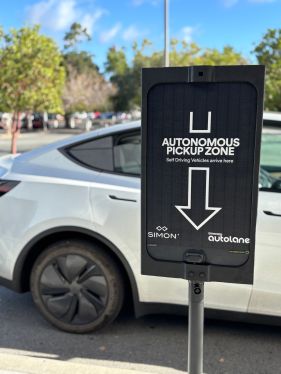
Backed by VC firms like Draper Associates and Hyperplane, Autolane said it will start by coordinating pickup and drop-off points for companies that want to let robotaxis come onto their private property. The startup has signed a deal with Simon Property Group to coordinate driverless vehicle arrivals and departures at shopping centers owned by the real estate company in Austin, Texas and San Francisco, California.
This deal will include creating simple, physical infrastructure like signage and also software. The company’s co-founder and CEO, Ben Seidl, described Autolane as one of the first ‘application layer’ companies in autonomy. He explained that they are not building the fundamental models or the cars, but instead aim to orchestrate and coordinate as the industry grows. Someone will have to sit in the middle and evaluate what’s going on.
Autolane is starting with robotaxis in mind, but Seidl is focused on the bigger-picture idea of applying his company’s tech to all kinds of tasks autonomous vehicles might perform in the future. He wants to move quickly because, as he sees it, the startup doesn’t have any direct competition right now, though he expects that to change soon.
Seidl said he was convinced there was a business here after buying a Tesla last year and using the company’s Full Self-Driving software for the first time. He was enthralled by the idea that this technology would change logistics, retail, real estate, and the price of moving goods, services, and people.
He cited an incident from earlier this year where a Waymo robotaxi got stuck navigating a Chick-fil-A drive-through in Santa Monica, California, as an example of the problem Autolane is trying to head off. In that case, the robotaxi had dropped off its passengers and then struggled to negotiate the lanes. Seidl said by using Autolane software and designating an exact pick-up and drop-off location, problems like this can be avoided. Someone has to bring order to the chaos that is already starting.
Companies could do some of this work themselves on the physical infrastructure side, such as making a sign. However, Seidl noted that robotics need precise instructions, precise geolocation, and technological communication. You cannot just put up a sign and hope for the best with many different types of robotics arriving.
Instead, Seidl said the value of Autolane is in how it will integrate with the companies that own real estate as well as with the autonomous vehicle providers. The plan is to essentially build APIs for the physical locations so autonomous vehicle companies can receive precise instructions. Businesses would otherwise have to directly integrate with each robotics or car company to enforce their rules.
Seidl also said he explicitly does not want to work with cities or municipalities. The company does not work on public streets or with public parking spots. They are providing these tools as a business-to-business, hardware-enabled software solution so that companies like Simon Property Group can begin to have what he calls ‘air traffic control for autonomous vehicles,’ meaning they know which ones are incoming and outgoing.