
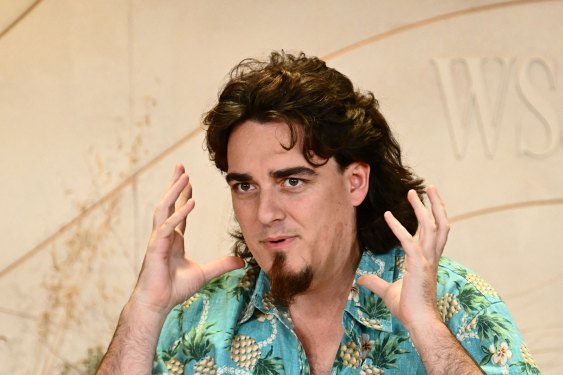
Palmer Luckey’s eyes light up and he talks a mile a minute when discussing his company’s new recruiting event: the AI Grand Prix. This is a drone flying contest with a twist. Rather than humans operating drones, the drones must operate autonomously. The humans will be tested on their software-writing skills that cause the drones to outfly their competition. Prizes range from a $500,000 pot to be split amongst the highest-scoring teams, to jobs at Anduril, and a chance to bypass the company’s standard recruiting cycle.
Luckey recalled the event’s origin during a team meeting about recruitment strategy. Someone suggested sponsoring a traditional drone racing tournament, which aligned somewhat with the company’s previous marketing tactics like sponsoring a NASCAR race. But Luckey pushed back, stating that would be a misstep for Anduril. He explained that the company’s entire reason for being is the advancement of autonomy to the point where a person does not need to micromanage each drone. He insisted they should instead sponsor a race about how well programmers and engineers can make a drone fly itself.
After discovering such an event did not exist, the company decided to create it themselves. Interestingly, the teams in the AI Grand Prix will not be flying Anduril’s drones, but those built by another defense tech startup, Neros Technologies. According to Luckey, Anduril’s drones are physically too large for the contained course in Ohio where the finals will take place. Anduril is partnering with the established Drone Champions League and JobsOhio to operate the event.
Although clearly excited about the event, Luckey confirmed he will not be a racer himself. He will attend, but emphasized the event is about who can build the best software to pilot these drones. He admitted he is not a very good software programmer, describing himself as more of a hardware, electromechanical, and optical guy who knows just enough about coding to glue prototypes together. He credits Anduril CEO Brian Schimpf as the company’s lead software brains.
Luckey is hoping for at least 50 teams and already has interest from multiple universities. Should this competition succeed, the plan is to expand into races with other types of autonomous vehicles. He shared ideas for future events including underwater AI racing, ground AI racing, and potentially even AI racing of spacecraft.
The contest is open to all international teams except those from Russia, citing the country’s active invasion of Europe. Luckey noted the concern that people qualified for the race may also work for their nation’s military, and stated that while he would love to include everyone, they are not the Olympics. He said the event is following the lead of the World Cup, which has also excluded Russia.
Teams from China, a hub for autonomous engineering, are welcome despite geopolitical tensions. However, Luckey clarified that should a Chinese team win, the prize of a job at Anduril would not be automatic. If someone works for the Chinese military, they would not be allowed to get a job at the company due to applicable laws. There will still be interviews and a qualification process for all job candidates.
The competition will take place across three qualifying rounds beginning in April, with the final Grand Prix race scheduled for November.