
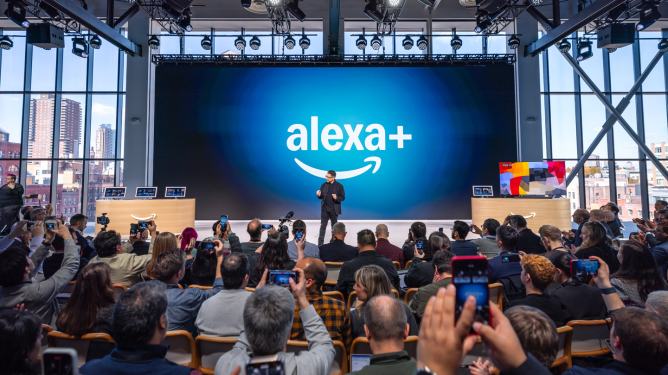
At the Consumer Electronics Show in Las Vegas last week, Amazon offered more insight into how it plans to compete in the AI arena. The company’s strategy centers on leveraging the massive installed base of its devices and the existing familiarity consumers have with the Alexa brand.
Amazon’s Vice President for Alexa and Echo, Daniel Rausch, noted that ninety-seven percent of the devices Amazon has ever shipped can support its new AI platform, Alexa+. He shared that the company has sold more than 600 million devices, and the vast majority of them will be compatible with this revamped assistant.
Alexa+, announced early last year, represents Amazon’s future in generative AI. It features more expressive voices, access to broad world knowledge, and AI agents that can perform tasks for users, such as calling a ride or ordering food. Amazon has been rolling out access gradually, with over one million Alexa customers gaining access by last June. Now, tens of millions of users can opt in to upgrade. While there is no exact date for a full public launch, the company is prioritizing making Alexa+ available to all Prime members first.
Beyond availability, Amazon must now prove that customers will actively use its AI. Rausch believes Alexa’s existing footprint will be a key advantage. He envisions a future with a range of AI assistants, where Alexa becomes one of the foundational, highly capable platforms, distinct from more specialized AIs. He points to customer familiarity, the tens of millions of users already engaged, and Alexa’s ambient, voice-first presence in the home as unique opportunities for growth.
These plans for the home come as the competitive landscape intensifies. Apple has announced a partnership with Google’s Gemini for Siri, while other AI chatbots like ChatGPT and Claude compete across various fields from research to coding.
Just before CES, Amazon announced web access for Alexa and a redesigned app with a chatbot-style interface. At the show, partners like Samsung, BMW, and Oura demonstrated new Alexa integrations. Amazon also highlighted its recent acquisition of Bee, an AI wearable that records conversations and provides insights through text or voice chat.
Rausch indicated that Alexa and Bee will become more integrated in the future. However, he also stated that Bee holds value as its own standalone brand, describing it as an important and lovable experience.