
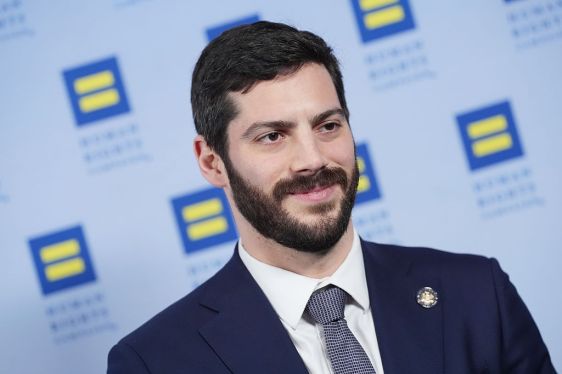
If you have seen the recent ads attacking New York assembly member Alex Bores, you likely know he once worked for Palantir, the AI company providing technology for controversial U.S. Immigration and Customs Enforcement raids and high-volume deportation efforts. The ads accuse Bores of making hundreds of thousands of dollars building the tech that powered those deportations.
However, that is not the full story. Bores stated that he quit Palantir specifically over its work with ICE in 2019. He is now running for New York’s 12th congressional district, while Big Tech billionaires fund outside groups targeting his campaign. The ads are funded by a super PAC called Leading the Future, which ironically has the backing of Palantir co-founder Joe Lonsdale, along with OpenAI President Greg Brockman, the venture firm Andreessen Horowitz, AI search startup Perplexity, and other Silicon Valley heavy-hitters. The PAC has raised $125 million to oppose candidates in state elections who are introducing AI legislation and to support candidates favoring a light-to-no-touch approach to AI regulation.
Bores said the group has committed to spending at least $10 million against him because they view him as their biggest threat in what he calls their quest for unbridled control over the American worker, our children’s minds, climate, and utility bills. He believes they are targeting him to make an example of him. Bores argues that his background working in tech, including at Palantir and several startups, is precisely why Leading the Future made him its first target. He said he actually deeply understands the technology and cannot be dismissed as someone who does not get it, adding that if elected, he would be only the second Democrat in Congress with a computer science degree.
Bores incurred the ire of Silicon Valley after sponsoring the RAISE Act, an AI transparency bill signed into law in December. The law requires large AI labs, specifically those making more than $500 million in revenue, to have a publicly available safety plan, to stick to it, and to report when a catastrophic safety incident occurs. It is the sort of light-touch law that other industries might welcome, focusing more on disclosure and planning than proactive oversight.
Bores says he does not believe Leading the Future wants any AI regulation, unless it is at the federal level as the PAC has stated. Over the last year, states have been fighting to protect their rights to regulate AI in the absence of a federal standard. In December, President Trump signed an executive order directing federal agencies to challenge what it called onerous state AI laws, like the RAISE Act. Bores pointed to his campaign’s proposed national AI governance blueprint, which spans eight issue areas and 43 policy recommendations, adding that anyone serious about federal AI regulation should be supporting him. He has also introduced legislation that would force companies to disclose what goes into their training data and to embed metadata standards to make synthetic content easier to trace.
Leading the Future is not the only Silicon Valley-backed PAC involved in the midterms. Meta has put $65 million into two super PACs to elect state-level candidates friendly to the AI and tech industry. AI companies, industry groups, and top executives donated at least $83 million in 2025 to federal campaigns and committees. Bores said this is not an attempt to have a piece of the conversation, but rather to intimidate elected officials and browbeat anyone who disagrees. He noted that the average assembly race in New York raises maybe $100,000 total, so for one company like Meta to spend $65 million on state races is far above the norm.
For his part, Bores has garnered the support of a separate Anthropic-backed PAC called Public First Action, which is spending $450,000 on his campaign. Public First Action also describes itself as pro-AI, but with a focus on transparency, safety, and public oversight. Bores says Leading the Future represents an extremely small minority of voices who see any regulation as a threat to AI progress and just want to let it rip. Among his base of supporters are tech workers at the very firms whose leaders want to thwart his campaign, reflecting a broader pattern of grassroots organizing inside tech companies over how AI is deployed and who it serves.
On the other end of the spectrum, Bores said, are a minority of people who want to pretend AI never existed and put the genie back in the bottle. He believes most Americans are somewhere in the middle: they use AI and see its potential but are concerned at how fast it is moving. They wonder if the government is up to the task of ensuring we have a future that benefits the many instead of the few.