
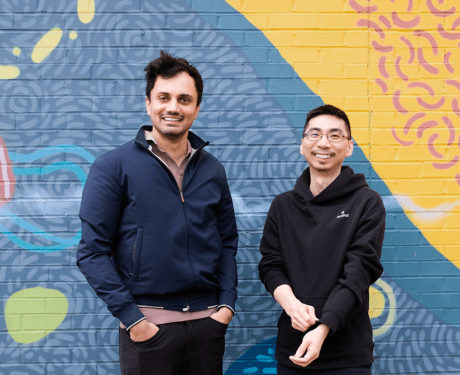
Runpod, an AI app hosting platform launched four years ago, has reached a $120 million annual revenue run rate. Founders Zhen Lu and Pardeep Singh shared their startup journey, a story that shows how building a solid product at the right time can attract success. Their path included bootstrapping to over $1 million in revenue, securing a $20 million seed round after a VC discovered them through Reddit posts, and gaining an angel investment from Hugging Face co-founder Julien Chaumond, who reached out via support chat after using their product.
The story began in late 2021 when the two friends, who worked together as corporate developers for Comcast, found their hobby no longer enjoyable. They had built specialized computers in their New Jersey basements to mine Ethereum. While they mined some cryptocurrency, it was not enough to repay their investment. Additionally, mining was set to end after Ethereum’s network upgrade known as “The Merge.” On top of that, Lu said the activity became boring after a few months. However, they had each invested around $50,000 into the hobby. Knowing that domestic harmony depended on finding a new use for their expensive graphics processing units, or GPUs, they needed a solution.
Both developers had experience with machine learning projects at work, so they decided to convert their mining rigs into AI servers. This was before the launch of ChatGPT and DALL-E 2. During the conversion, they encountered major frustrations with the existing software for managing GPUs. As developers, they identified a problem they wanted to solve. Runpod was born from their belief that the experience of developing software on GPUs was severely lacking.
By early 2022, they were ready to share their creation. Runpod is a platform for hosting AI applications, focusing on speed, easily configured hardware, and developer tools like APIs and command-line interfaces. Initially, they had only a few integrations. Their next challenge was finding beta testers. As first-time founders with no marketing experience, Lu decided to simply post on a few AI-focused subreddits. They offered free access to their AI servers in exchange for feedback. The strategy worked, attracting beta users who later became paying customers. Within nine months, they had quit their jobs and reached $1 million in revenue.
This growth led to a new problem. Business users expressed they could not run critical operations on servers located in personal basements. The founders had not considered raising venture capital initially. Instead, they formed revenue-share partnerships with data centers to expand capacity. This period was stressful, as they had to constantly anticipate demand to ensure users did not leave for competitors due to a lack of available GPUs.
Their user base continued to grow on platforms like Reddit and Discord, especially after the launch of ChatGPT. Venture capitalists also began taking notice. Investor Radhika Malik saw their Reddit posts and reached out for their first VC meeting. Lu admitted he did not know how to pitch to an investor, but Malik was helpful, explaining how VCs think and promising to stay in touch. For nearly two years, Runpod operated without external funding. The company never offered a free tier, insisting that the business at least pay for itself without taking on debt, unlike some other AI cloud services that started as crypto miners.
By May 2024, with AI application fever spreading, their early decision to launch an AI hosting platform was paying off. Their business had grown to 100,000 developers, and they secured a $20 million seed funding round co-led by the venture arms of Dell and Intel, with participation from notable figures like Nat Friedman and Julien Chaumond. They have not raised additional money since but are now planning to, believing their business merits a healthy Series A round.
Today, Runpod serves 500,000 developers, ranging from individuals to Fortune 500 enterprise teams with multimillion-dollar annual spends. Their cloud infrastructure spans 31 global regions and includes customers like Replit, Cursor, OpenAI, Perplexity, Wix, and Zillow. The competitive landscape is fierce, with developers able to choose from major clouds like AWS, Microsoft, and Google, as well as industry-specific providers. However, the founders see Runpod’s role differently—as a developer-centric platform. They believe coding will evolve rather than disappear, with programmers becoming creators and operators of AI agents. Their goal is to be the foundation for this next generation of software developers.