
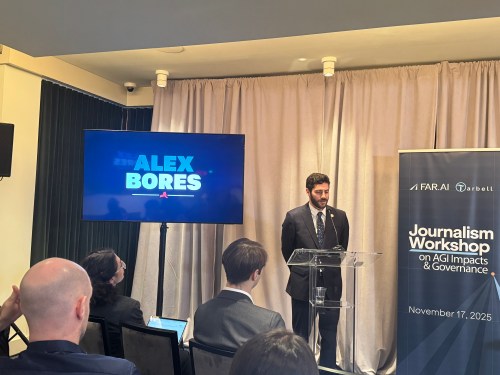
A pro-AI super PAC backed by Andreessen Horowitz and OpenAI President Greg Brockman has chosen New York Assembly member Alex Bores and his congressional bid as its first target. The PAC, called Leading the Future, formed in August with a more than one hundred million dollar commitment to support policymakers who favor a light-touch or no-touch approach to AI regulation. This means the group will oppose policymakers who want to regulate AI. The super PAC has backing from other prominent tech leaders, including Palantir co-founder and 8VC managing partner Joe Lonsdale, as well as the AI search engine Perplexity.
Alex Bores said he appreciates how straightforward the group is being about its intentions. He stated that when they say they will spend millions against him because he might regulate Big Tech and put basic guardrails on AI, he simply forwards that message to his constituents. Bores is running to represent New York’s 12th Congressional District. He said AI anxieties are rising among his constituents, who worry about issues ranging from data centers increasing utility bills and worsening climate change to chatbots impacting children’s mental health and automation transforming the job market.
Bores is the chief sponsor of New York’s bipartisan RAISE Act. This bill requires large AI labs to have a safety plan in place to prevent critical harms, follow their own safety plans, and disclose critical safety incidents, such as bad actors stealing an AI model. The bill also prohibits AI firms from releasing models with unreasonable risks of critical harm and imposes civil penalties of up to thirty million dollars if companies fail to meet these standards. The legislation is currently awaiting Governor Kathy Hochul’s signature.
While drafting the bill, Bores consulted with large AI firms like OpenAI and Anthropic. Those negotiations led to the removal of provisions like third-party safety audits, which he says the industry refused to accept. Despite these compromises, the RAISE Act and Bores himself appear to have angered Silicon Valley. The heads of Leading the Future, Zac Moffatt and Josh Vlasto, stated they would work on a multibillion-dollar effort to defeat Bores’ campaign.
In a statement, they accused Bores of advancing ideological and politically motivated legislation that would handcuff New York’s and the entire country’s ability to lead on AI jobs and innovation. They said bills like the RAISE Act threaten American competitiveness, limit economic growth, leave users exposed to foreign influence, and undermine national security. They called the RAISE Act a clear example of patchwork, uninformed state laws that would slow American progress and open the door for China to win the global race for AI leadership. They argued that America needs one clear and consistent national regulatory framework for AI that strengthens the economy and protects users.
Many in Silicon Valley have pushed to prohibit states from passing AI regulations. Earlier this year, a provision blocking state AI laws was slipped into the federal budget bill but was later removed. Now, lawmakers like Senator Ted Cruz are seeking to resurrect it through other legislative avenues.
Bores said he is concerned such a movement could gain traction at a time when the federal government has passed no meaningful AI regulation. He believes that where the federal government moves slowly, states can function like policy laboratories and move fast to test what works. Bores stated the question should be whether Congress has solved the problem. He said if Congress solves the problem, then it can tell the states to get out of the way. But if they are not going to pass a bill that actually addresses any problems and then say states cannot do anything, that just does not make sense to him.
Bores also noted he has been in contact with policymakers in other states to work on standardizing legislation, which could combat the patchwork objection from Silicon Valley. He also believes lawmakers should ensure there are no redundancies with the EU AI Act. Bores emphasized that AI regulation is not meant to limit innovation, and that he has rejected bills he thinks would have unintended consequences for the industry. He stated that having basic rules of the road is actually a very pro-innovation stance if done well. He fundamentally believes that the AI which wins will be the AI that is trustworthy. He said the pushback from industry claiming that government has no role in establishing that trust is something he sees people rejecting at every level.